
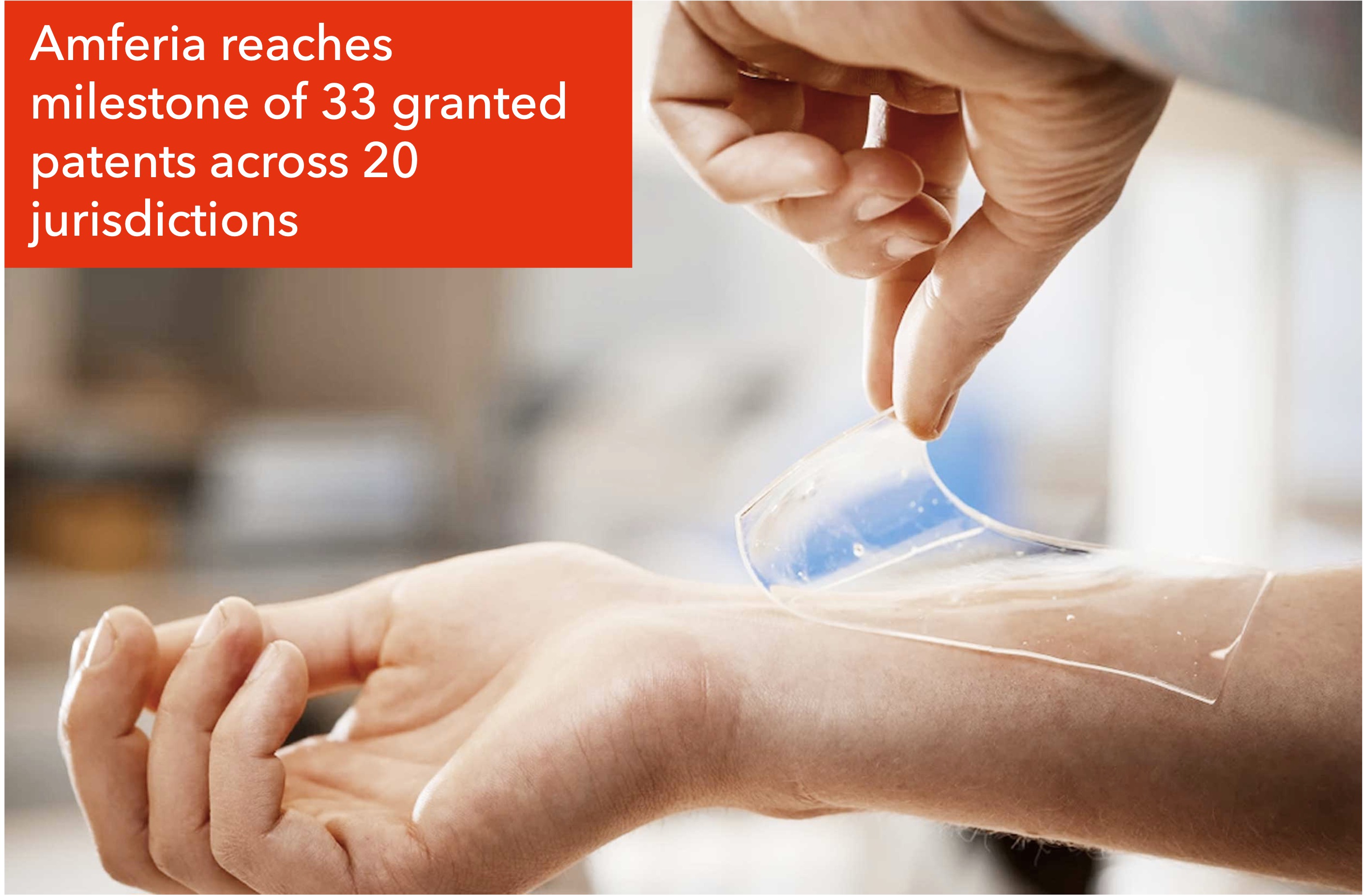
From a single novel hydrogel patent filed in 2017 to a portfolio of 50 applications worldwide, Amferia’s IP strategy mirrors the depth and rigor of the science that earned the company an FDA DeNovo Classification—and signals a company built to compete at scale.
Amferia, today announced it has reached 33 granted patents across 20 jurisdictions globally, with a total portfolio of 50 patent applications representing four distinct technology families. The milestone reflects Amferia’s disciplined strategy for developing intellectual property as a core asset—which positions the company for commercial development following the granting of FDA approval in the De Novo Classification for their unique wound care product.
A foundational patent worth building on
Amferia first became interested in a patent strategy in 2017, when Anand Kumar Rajasekharan and Saba Atefyekta—then PhD researchers at Chalmers University of Technology in Gothenburg—teamed with Martin Andersson, their faculty adviser at the time, to conceive of a new class of antimicrobial material. Surprised by their discoveries, the team approached a patent attorney with a dataset and a question: what can we protect? The answer, it turned out, was something genuinely new.
The company’s first patent covered a hydrogel built around a specific nanostructure—one in which hydrophobic and hydrophilic regions alternate at the nanoscale with a remarkable lattice-like regularity. The repeating structure allows antimicrobial peptides to attach in a precise, aligned way that irregular hydrogels could not replicate. As the FDA De Novo Classification verifies, no other group had achieved the same results from the same materials. A broad patent was issued in every major jurisdiction the team pursued. (Canada remains pending, consistent with characteristically longer timelines.)
“Patents weren’t an afterthought with this team,” said David Henricson Briggs, the patent attorney who has worked with Amferia since its founding. “When they saw their scientific results, they started thinking about how they would build their patent strategy and very quickly got in touch to begin that process.”
That carefulness in building patent protections has significant business implications now.
Four families with future potential
Each subsequent patent family Amferia has been granted emerged not from incremental reformulations, but from genuine scientific surprise. The company’s portfolio now spans four distinct technology families:
Family 1: The Hydrogel Nanostructure. This patent covers Amferia’s foundational technology: an amphiphilic nanostructured hydrogel that binds antimicrobial peptides with exceptional stability. The hydrogel kills 99.99% of bacteria it comes in contact with and destroys even antibiotic-resistant strains of bacteria.
Family 2: Solid Biomaterial Structures. Developed concurrently with the original research, this family covers more rigid, implant-grade structures built from the same materials — extending the platform’s potential well beyond wound care dressings.
Family 3: Hemostatic Activity (blood coagulation). During pre-clinical testing of their antimicrobial wound dressing, the researchers at Amferia made another striking discovery: the antimicrobial peptide they used also promoted blood clotting. The family of patents protecting this discovery was granted in multiple jurisdictions and is pending in the US.
Family 4: Endotoxin Neutralization. The company’s most recent patent filings address a challenge inherent to any effective antimicrobial: when bacteria are killed in large numbers, they release endotoxins that can harm the body. Amferia found that its peptide neutralizes these endotoxins, further strengthening the product’s clinical case. Applications are filed globally; European grant is anticipated in the near term.
Quality over volume: a portfolio built to grow
Amferia’s patent strategy stands in deliberate contrast to the “shotgun” approach common among competitors with more capitalization, where volume of filings can substitute for depth of invention. Amferia’s patent filing represent inventive steps—genuinely new discoveries, as opposed to marginal changes in concentration or formulation.
“Amferia hasn’t had the resources to file 100 patents and drop 90 of them,” Henricson Briggs said. “What that means is their portfolio is a pleasure to work with. There’s a high level of inventiveness. We’re often saying, ‘Nobody has ever seen this before.’ They’ve been developing truly revolutionary things. Everything in their portfolio is valuable.”
The company’s disciplined approach also reflects organizational maturity unusual for a startup. Amferia consistently engages patent counsel early—before publication, before partnerships, before press—protecting discoveries at the moment of creation rather than racing to do it after the fact.
New IP in active development
With commercial development underway in both human and animal health—Amferia is actively seeking partners to address the opportunities that FDA approval has opened while partnered with several animal wound care companies for distributing veterinary products in Europe—Amferia is still developing new patents involving its core material and new products. This work demonstrates that the platform has potential to continue evolving.